Splitter
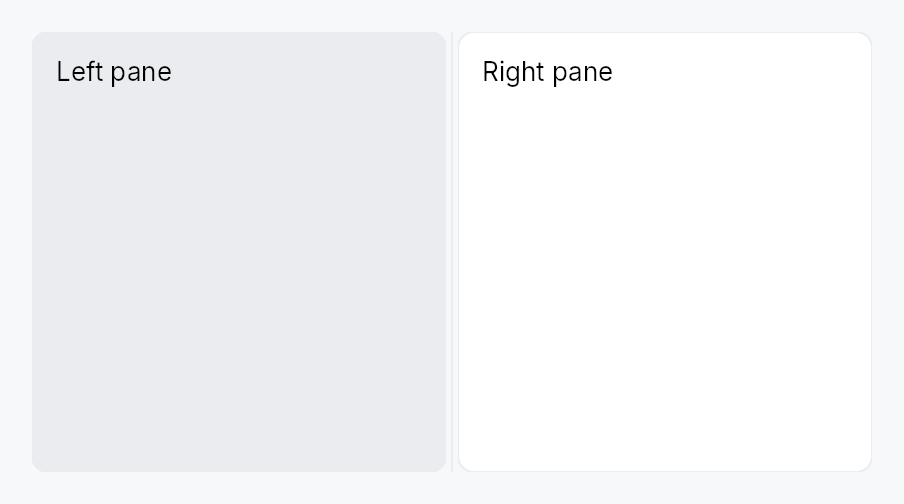
N-pane split container with draggable, collapsible dividers.
Splitter arranges N ≥ 2 panes along one axis (per Orientation)
with N − 1 grabbable handles between them — the Qt QSplitter
model. All layout state (per-pane size / min / max / stretch /
collapsed) lives in a shared, cloneable SplitterModel; the app
holds a clone to read, mutate, persist, and import/export, while the
widget renders it and reacts to the model's version signal.
Strengths carried over from the old two-pane SplitView: anti-jump
drag, keyboard resize, Role::Splitter accessibility, per-pane content
clipping, RTL-correct horizontal layout. New: N panes, per-pane
stretch (container-resize policy), animated collapse with four triggers
(programmatic / double-click / drag-past-min snap / keyboard), a Tier-3
SplitterStyle, and serializable import/export. Intended as the
building block for a future DockingLayout.
let model = SplitterModel::from_panes(vec![
    PaneDescriptor::new().size(220.0).min_size(160.0).stretch(0.0).collapsible(true),
    PaneDescriptor::new().stretch(1.0).min_size(320.0),
    PaneDescriptor::new().size(280.0).stretch(0.0).collapsible(true),
], Orientation::Horizontal);

Splitter::new(model.clone())
    .pane(sidebar).pane(editor).pane(inspector)
    .pane_label(0, tr!(sidebar()));
Builder methods at a glance
pane, pane_id, child, pane_label, style, enabled
API reference
📖 Full rustdoc API for this module
pub struct Splitter
An N-pane resizable split container driven by a SplitterModel.
See the module-level documentation for a usage overview and
constructor patterns.
#![allow(unused)]
fn main() {
pub struct Splitter { /* fields */ }
}
Methods
pub fn new(model: SplitterModel) -> Self
Create a Splitter bound to the given model. Panes must be appended
with pane in model order.
pub fn pane(mut self, widget: impl Widget + 'static) -> Self
Append a content pane (model order). Call once per pane; the count
must match model.pane_count().
pub fn pane_id(mut self, id: WidgetId) -> Self
Append a pre-registered content pane by id.
pub fn child(self, widget: impl Widget + 'static) -> Self
teksu! ergonomic alias for pane: a bare child in a
Splitter { ... } block lowers to .child(...).
pub fn pane_label(mut self, index: usize, label: impl Into<Prop<String>>) -> Self
Set an accessible region name for pane index (locale-reactive).
Labeled panes become a named Role::Group; unlabeled panes stay
AT-transparent (their content represents itself).
pub fn style(mut self, style: impl SplitterStyle) -> Self
Override the active SplitterStyle for this instance only.
pub fn enabled(mut self, enabled: impl Into<Prop<bool>>) -> Self
Enable or disable handle dragging, statically or reactively. When
false, divider handles are rendered inert — the pane layout is
still valid but the user cannot resize panes.
pub struct PaneDescriptor
Per-pane configuration passed to SplitterModel::from_panes /
SplitterModel::insert_pane. Public fields + Default so it can
be built with struct-literal ..Default::default() syntax, or via the
fluent setters.
#![allow(unused)]
fn main() {
pub struct PaneDescriptor { /* fields */ }
}
Methods
pub fn new() -> Self
pub fn size(mut self, size: f32) -> Self
pub fn min_size(mut self, min: f32) -> Self
pub fn max_size(mut self, max: f32) -> Self
pub fn stretch(mut self, stretch: f32) -> Self
pub fn collapsible(mut self, collapsible: bool) -> Self
pub fn collapsed(mut self, collapsed: bool) -> Self
pub fn collapsed_size(mut self, px: f32) -> Self
Size a collapsed pane folds down to (default 0). See
collapsed_size.
pub fn visible(mut self, visible: bool) -> Self
pub struct PaneSnapshot
Immutable per-pane view handed to the pure distribute sizing
function (the internal splitter::distribute engine).
#![allow(unused)]
fn main() {
pub struct PaneSnapshot { /* fields */ }
}
pub struct PaneState
Persistable per-pane layout state. Captures the user-controllable
values (size + collapsed); structural config (min/max/stretch/
collapsible) is app-declared and not serialized — Qt saveState
parity.
#![allow(unused)]
fn main() {
pub struct PaneState { /* fields */ }
}
pub struct SplitterState
Full serializable snapshot of a SplitterModel's sizes + collapsed
flags. Round-trips through SplitterModel::export_state /
import_state and implements
Versioned so apps persist it through
SettingsFile<SplitterState> + Migrator (TOML).
#![allow(unused)]
fn main() {
pub struct SplitterState { /* fields */ }
}
pub struct SplitterModel
A shared, cloneable handle to a splitter's layout state. Clone =
share-by-handle (cheap Rc bump).
#![allow(unused)]
fn main() {
pub struct SplitterModel(Rc<RefCell<SplitterModelInner>>);
}
Methods
pub fn new(n: usize, orientation: Orientation) -> Self
n equal-share panes (each stretch = 1, min = SPLITTER_MIN_PANE_SIZE).
pub fn from_panes(panes: Vec<PaneDescriptor>, orientation: Orientation) -> Self
Build from explicit per-pane descriptors.
pub fn handle_count(&self) -> usize
Number of distinct handles to this model (1 = unshared).
pub fn set_stored_size(&self, index: usize, size: f32)
pub fn set_stored_size_silent(&self, index: usize, size: f32)
Like set_stored_size but without a version
bump — for writes made from inside a layout/effect pass that is already
relaying out (e.g. capturing the displayed size as the collapse
reference), where a bump would re-enter the effect.
pub fn set_pair_sizes(&self, index: usize, size_a: f32, size_b: f32)
Set both sides of handle index (panes index and index+1) in
one mutation — a single version bump, so a drag produces exactly
one relayout per move.
pub fn set_min_size(&self, index: usize, min: f32)
pub fn set_max_size(&self, index: usize, max: Option<f32>)
pub fn set_stretch(&self, index: usize, stretch: f32)
pub fn set_collapsible(&self, index: usize, collapsible: bool)
pub fn set_collapsed(&self, index: usize, collapsed: bool)
Programmatically collapse/expand pane index, animated. Ignores
the collapsible flag (that flag only gates interactive triggers).
pub fn set_collapsed_immediate(&self, index: usize, collapsed: bool)
Collapse/expand pane index instantly (no tween). Used by the
drag handlers — the pointer is already the motion.
pub fn toggle_collapsed(&self, index: usize)
Toggle pane index's collapsed state, animated.
pub fn set_collapsed_size(&self, index: usize, px: f32)
Set the size pane index folds down to when collapsed (default 0).
See PaneDescriptor::collapsed_size. No version bump on its own — it
only affects the next collapse.
pub fn set_pane_visible(&self, index: usize, visible: bool)
Show or hide pane index (animated). A hidden pane removes both the
pane and an adjacent gutter from the layout — it reads as absent,
unlike a collapsed pane (which keeps its grabbable gutter). The pane
must be pre-mounted in the Splitter; this is the reactive "add /
remove a pane from a fixed set" trick (no rebuild).
pub fn is_pane_visible(&self, index: usize) -> bool
pub fn consume_animate_flag(&self) -> bool
Read-and-reset the "animate the next collapse change?" latch. The
widget's collapse effect calls this once per version bump; it
resets to true so the default (programmatic) path animates.
pub fn insert_pane(&self, index: usize, desc: PaneDescriptor)
Insert a pane at index (clamped to [0, len]). A None
initial_size takes the average of the existing panes' sizes; the
next layout rebalances. The app must rebuild the Splitter widget
to supply the new pane's content (retained-mode: changing a
container's child set is a rebuild; the model keeps the
persistent size/collapse state across it).
pub fn remove_pane(&self, index: usize)
Remove the pane at index (no-op if out of range). The app must
rebuild the Splitter widget to drop the corresponding content.
pub fn replace_pane_desc(&self, index: usize, desc: PaneDescriptor)
Replace the metadata of pane index (keeps its current size unless
the descriptor specifies one).
pub fn set_gutter_thickness(&self, thickness: f32)
pub fn set_snap_offset(&self, offset: f32)
pub fn set_keyboard_step_px(&self, step: f32)
pub fn set_orientation(&self, orientation: Orientation)
pub fn pane_count(&self) -> usize
pub fn stored_size(&self, index: usize) -> f32
pub fn min_size(&self, index: usize) -> f32
pub fn max_size(&self, index: usize) -> Option<f32>
pub fn stretch(&self, index: usize) -> f32
pub fn is_collapsible(&self, index: usize) -> bool
pub fn collapsed_size(&self, index: usize) -> f32
The size pane index folds to when collapsed (default 0). See
PaneDescriptor::collapsed_size.
pub fn is_collapsed(&self, index: usize) -> bool
pub fn orientation(&self) -> Orientation
pub fn gutter_thickness(&self) -> f32
pub fn snap_offset(&self) -> f32
pub fn keyboard_step_px(&self) -> f32
pub fn version(&self) -> Signal<u64>
The reactive version signal. The Splitter widget binds this at
BindingLevel::Relayout.
pub fn pane_snapshots(&self) -> Vec<PaneSnapshot>
Immutable per-pane snapshot for the pure sizing engine.
pub fn export_state(&self) -> SplitterState
Snapshot the per-pane sizes + collapsed flags into a serializable
SplitterState.
pub fn import_state(&self, state: &SplitterState) -> bool
Restore sizes + collapsed flags from a SplitterState. Returns
false (and changes nothing) if the pane count doesn't match — the
structural config must be reconstructed first. Restoration is
instant (collapsed panes don't animate open on load).