NotificationLog
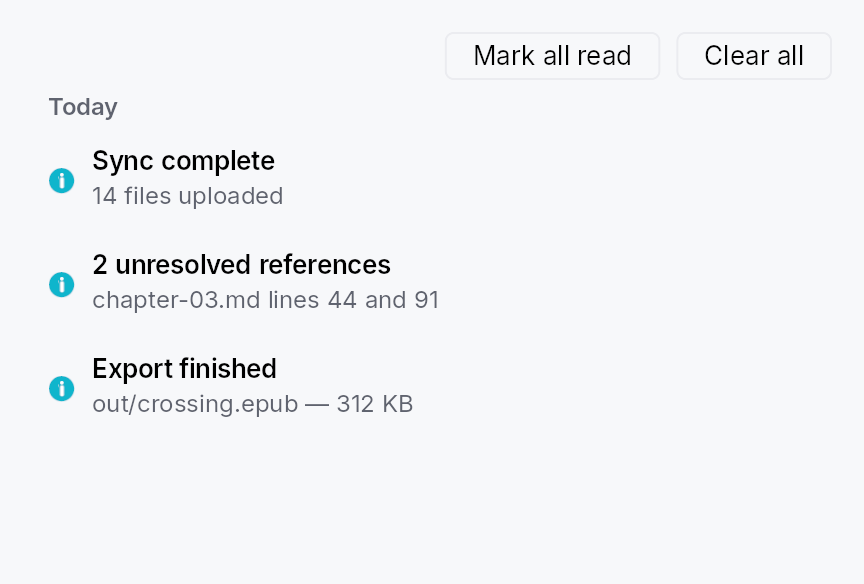
NotificationLog — a scrollable, day-bucketed list of archived notifications.
Renders a NotificationArchiveModel as a scrollable column of
StandardListItem rows grouped under section headers (Today /
Yesterday / This week / Earlier), computed against the user's local
timezone on every archive mutation. An optional toolbar row provides
mark-all-read and clear buttons. Unread rows show the title in
BodyBold; read rows use Body. An empty-state hint is shown when the
archive is empty.
Sizing
The log grows into a host that bounds its height and compresses
inside one shorter than its natural height (floored at one row);
only a host that hugs its content — which is how the overlay layer
measures the NotificationCenterButton
popover — falls back to preferred_width /
preferred_height. Row text is
elided, not wrapped, with the full text on the row's rich
tooltip: notification prose is arbitrary and the log does not
control its own width, so a wrapping row would over-constrain
itself and push its trailing action buttons out of view.
When to use
- Embed directly inside a side panel or settings page for an in-app notification centre.
- Wrap in
NotificationCenterButtonfor the standard bell-icon-with-popover pattern. - Call
NotificationLogDialog::showfor a one-line modal presentation.
let archive: Rc<NotificationArchiveModel> = ctx.app_state().unwrap();
let log = NotificationLog::new(archive)
    .on_action_invoked(|_entry, action, ctx| {
        if let Some(name) = &action.intent_name {
            ctx.send_intent(teksilo_core::Intent::new(name));
        }
    });
Builder methods at a glance
for_window, for_audience, show_toolbar, empty_state, preferred_width, preferred_height, on_entry_invoked, on_action_invoked
API reference
📖 Full rustdoc API for this module
pub struct NotificationLog
Configurable archive log. Shipped chrome:
- mark-all-read + clear buttons in a toolbar row;
- empty-state hint when the archive is empty;
- day-bucket section headers (Today / Yesterday / This week / Earlier) above the rows for each bucket — computed against the user's local timezone, recomputed on every archive mutation;
StandardListItemrows with unread-as-bold differentiation.
A SearchField filter and a severity-chip filter can be composed by apps using the existing widget toolkit.
#![allow(unused)]
fn main() {
pub struct NotificationLog { /* fields */ }
}
Methods
pub fn new(archive: Rc<NotificationArchiveModel>) -> Self
Construct a log bound to the shared archive. The archive is
expected to outlive the log (typically held in app_state).
pub fn for_window(mut self, window_id: TeksiloWindowId) -> Self
Scope this log to entries routed to window window_id (plus
any Broadcast entry) — the shape a NotificationCenterButton
mounted in that window wants for its popover body. Overrides
any previous for_window / for_audience call.
pub fn for_audience(mut self, audience: ToastAudience) -> Self
Scope this log to entries routed to audience (plus any
Broadcast entry). Overrides any previous for_window /
for_audience call.
pub fn show_toolbar(mut self, show: bool) -> Self
Whether to render the toolbar row (mark-all-read + clear).
Default true. Apps that want a chrome-less log (e.g. inside
a custom panel that supplies its own toolbar) pass false.
pub fn empty_state(mut self, f: impl Fn() -> Box<dyn Widget> + 'static) -> Self
Override the empty-state hint. Default: a centered "No notifications" text. Pass a factory returning any widget for a custom empty view (illustration, call-to-action, …).
A factory rather than a widget because the log rebuilds on every archive mutation: the view has to be re-creatable each time the archive goes empty again, not just the first time.
log.empty_state(|| Box::new(TextWidget::new(tr!(inbox_zero()))))
pub fn preferred_width(mut self, width: f32) -> Self
Width the log reports when the host proposes an unbounded one.
Default 380 dp.
This is load-bearing for the popover presentation
(NotificationCenterButton):
the overlay layer measures its content with a fully unbounded
proposal, and a StandardListItem asked for an intrinsic
width reports only its chrome, so without a preferred width the
popover would size itself to whatever the two toolbar buttons
happen to measure (~248 dp with the stock labels) and elide
every title to a stub. Hosts that DO bound the width (a dialog,
a side panel) ignore this value.
pub fn preferred_height(mut self, height: f32) -> Self
Height of the scrolling list area when the host proposes an
unbounded height. Default 320 dp.
The log always grows into a host that bounds its height (it reports a flex weight), so this only sets the natural height a content-hugging host — again, the popover — sizes itself to.
pub fn on_entry_invoked( mut self, f: impl Fn(&NotificationEntry, &mut EventContext) + 'static, ) -> Self
Called when the user clicks anywhere on an archived entry's row body (outside any specific action button). The default behaviour is no-op — the log is read-only display unless callers wire this hook.
pub fn on_action_invoked( mut self, f: impl Fn(&NotificationEntry, &ArchivedAction, &mut EventContext) + 'static, ) -> Self
Called when an archived action button is clicked. Apps wire
this hook to replay the action — typically by mapping the
ArchivedAction::intent_name to one of the app's registered
Actions via ctx.send_intent(...). Without this hook
configured the action buttons are inert (the log keeps them
visible for archival context).
Actions without an intent_name render as non-clickable
past-action tags regardless of this hook — there's nothing
for the framework to dispatch against once the live closure
has torn down.
log.on_action_invoked(|_entry, action, ctx| {
    // Bridge the dynamic intent_name to one of the app's
    // typed AppIntent variants:
    match action.intent_name.as_deref() {
        Some("app.build.retry") => ctx.send_intent(AppIntent::BuildRetry),
        Some(name) => log::warn!("unknown archived intent: {name}"),
        None => {}
    }
})