DropTarget
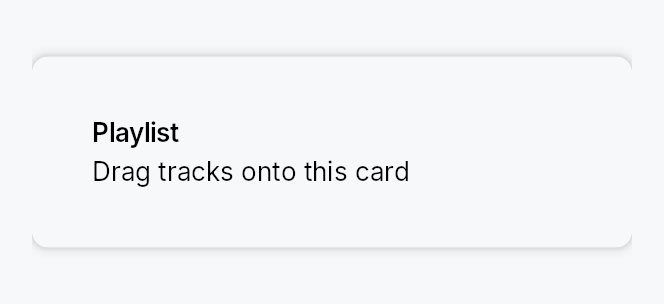
DropTarget — a transparent wrapping drop container.
Where DropZone is a standalone "drop files
here" placeholder with its own label / icon / Browse button, DropTarget is
a wrapping container: it turns any existing widget subtree into a drop
target without replacing its visual identity. The wrapped child fills the
bounds and is always visible; the widget adds a reactive highlight border +
tint while a drag hovers and, if a hint slot is set, fades in a centered
popup card ("Drop your image here").
It reacts to both internal drags (typed DragPayload) and external
(OS) drops (files / text / URIs), through the framework's normal drag
pipeline (on_drag_hover / on_drag_leave / on_drop).
// Wrap a panel; accept image files; show a hint while hovering.
DropTarget::new()
    .child(my_panel)
    .hint(TextWidget::new(lit!("Drop your image here")))
    .accept_external_extensions(["png", "jpg", "jpeg"])
    .on_drop(|payload, _pos, _ctx| { import(payload.files()); true });

// Typed internal drag — recovers the value even after an OS round-trip
// or across windows (the framework's typed re-entry).
DropTarget::new()
    .child(project_card)
    .on_drop_typed::<ProjectRef>(|project, _pos, ctx| {
        ctx.send_intent(AppIntent::Link(project));
        true
    });
Multi-zone drops
Beyond the single whole-bounds target, a DropTarget can expose up to five
independently enable-able DropRegions — Center / Top / Bottom /
Leading / Trailing — each with its own optional hint, and route the drop
by which zone the pointer released over. This is the VS Code-style
"drop on the centre to add, drop on an edge to split" affordance
(DockingLayout computes the same five zones by hand). Declare regions with
DropTarget::region; the side zones share one DropTarget::zone_size_factor
(0.1..=1.0, the fraction of the axis each edge strip occupies — 0.2 is the
default fifth, 0.5 bisects) so you size them to the context. Route with
DropTarget::on_region_drop (or observe DropTarget::active_region_signal).
DropTarget::new()
    .child(editor_pane)
    .zone_size_factor(0.25)
    .region(DropRegion::Center,   |z| z.hint(TextWidget::new(lit!("Add as tab"))))
    .region(DropRegion::Leading,  |z| z.hint(TextWidget::new(lit!("Split left"))))
    .region(DropRegion::Trailing, |z| z.hint(TextWidget::new(lit!("Split right"))))
    .on_region_drop(|region, payload, _pos, ctx| { route(region, payload); true });
Declaring any region switches the target to exactly the declared regions;
declaring none keeps the Center-only whole-bounds default (.hint(w) is
sugar for .region(DropRegion::Center, |z| z.hint(w))). Leading / Trailing
map to left / right — the framework surfaces no writing direction on the
layout context yet, so RTL mirroring is a follow-up.
Each zone can be reactively enabled with z.enabled(signal) (default
true): a bound Signal<bool> disables the zone live — no rebuild — and its
strip then falls through to the next-priority enabled zone (or Center, or
rejects). A drop landing in a middle covered by no enabled zone is rejected;
on_region_drop therefore only ever receives an enabled region.
Styling
The per-zone highlight overlay + hint chrome is a Tier-3 DropTargetStyle;
the default RecipeDropTargetStyle
paints the active zone (centre → frame only, so the wrapped content shows
through; an edge strip → translucent fill + accent frame) and a full-bounds
error border on reject. Override per-call with DropTarget::style or
theme-wide via theme.style_slots.drop_target.
Accessibility
The wrapper is a Role::Group. Live is intentionally not set on the
group (that would announce every change to the wrapped child); instead the
recipe scopes Live::Polite to each hint card so a screen reader announces
the active zone's hint appearing. Each hint is gated by visible_when, so a
non-active zone's hint leaves the AT tree entirely.
Keyboard accessibility is the caller's responsibility
An OS drag cannot be initiated from the keyboard, and — unlike
DropZone, which ships a keyboard-operable
Browse… button as its WCAG 2.1.1 equivalent — DropTarget adds no
keyboard affordance of its own. That is by design: DropTarget wraps
existing content that is expected to already offer a keyboard path to the
same outcome (e.g. a card you can drop a project onto or open with a
context-menu "Link…" command). The drop is an enhancement, not the sole
path.
If you use DropTarget for an action that has no other affordance, you
must add a keyboard equivalent yourself (a button, menu item, or shortcut) —
otherwise the action is unreachable for keyboard-only users, and entirely
unavailable on platforms with no external-DnD backend (e.g. X11, where OS
drag-and-drop is a no-op). DropZone is the better choice when the drop
is the primary action.
Builder methods at a glance
child, child_id, region, zone_size_factor, hint, hint_id, accept_any, accept_external, accept_external_files, accept_external_text, accept_external_extensions, accept_typed, accept_when, targeted_signal, drag_state_signal, active_region_signal, on_drop, on_drop_typed, on_region_drop, on_drag_leave, variant, style
API reference
📖 Full rustdoc API for this module
pub struct DropRegionSpec
Per-region configuration for a multi-zone [DropTarget]: an optional hint
plus a reactive enabled flag. Kept as a struct so more per-zone knobs can
land without a signature churn.
#![allow(unused)]
fn main() {
pub struct DropRegionSpec { /* fields */ }
}
Methods
pub fn new() -> Self
An enabled spec with no hint.
pub fn hint(mut self, widget: impl Widget + 'static) -> Self
Widget shown (centered in this region's rect, inside a popup card) while a drag with an accepted payload hovers this region.
pub fn hint_id(mut self, id: WidgetId) -> Self
This region's hint content by pre-registered WidgetId.
pub fn enabled(mut self, enabled: impl Into<Prop<bool>>) -> Self
Whether this zone is active — static or signal-bound (default true). A
bound Signal<bool> enables/disables the zone live, without a rebuild:
while disabled the zone stops hit-testing (its area falls through to the
next-priority enabled zone, or Center, or rejects), never highlights,
and never shows its hint. The enabled state is resolved on every drag
tick, so a .set(false) mid-drag takes effect on the next hover.
pub struct DropTarget
A transparent container that turns its child into a drop target. See the module docs.
#![allow(unused)]
fn main() {
pub struct DropTarget { /* fields */ }
}
Methods
pub fn new() -> Self
A drop target with no child yet — call Self::child (required).
pub fn child(mut self, widget: impl Widget + 'static) -> Self
The wrapped content — fills the bounds and is always visible.
pub fn child_id(mut self, id: WidgetId) -> Self
The wrapped content by pre-registered WidgetId.
pub fn region( mut self, region: DropRegion, f: impl FnOnce(DropRegionSpec) -> DropRegionSpec, ) -> Self
Enable and configure a drop DropRegion. Declaring any region
switches the target to exactly the declared regions; declaring none
leaves the implicit Center-only whole-bounds default. The spec closure
configures the region (currently: an optional hint).
DropTarget::new()
    .child(editor)
    .zone_size_factor(0.25)
    .region(DropRegion::Center,   |z| z.hint(TextWidget::new(lit!("Add tab"))))
    .region(DropRegion::Leading,  |z| z.hint(TextWidget::new(lit!("Split left"))))
    .region(DropRegion::Trailing, |z| z.hint(TextWidget::new(lit!("Split right"))))
    .on_region_drop(|region, payload, _pos, ctx| { route(region, payload); true });
pub fn zone_size_factor(mut self, factor: f32) -> Self
The fraction of the axis each side zone occupies (clamped to
0.1..=1.0). 0.2 is the default fifth; 0.5 bisects. Applies to all
four edge zones in common; Center takes the leftover middle.
pub fn hint(mut self, widget: impl Widget + 'static) -> Self
Widget shown centered inside a popup card while a drag with an accepted
payload hovers. Sugar for .region(DropRegion::Center, |z| z.hint(w)) —
the classic whole-bounds single-zone case.
pub fn hint_id(mut self, id: WidgetId) -> Self
Hint content by pre-registered WidgetId (Center region).
pub fn accept_any(mut self) -> Self
Accept any payload (internal or external). Explicit form of the default.
pub fn accept_external(mut self) -> Self
Accept any external (OS) drop, regardless of content.
pub fn accept_external_files(mut self) -> Self
Accept external drops that carry at least one file. Optimistic at hover
on Wayland (where the file bytes only arrive at drop) if the source
advertises a text/uri-list.
pub fn accept_external_text(mut self) -> Self
Accept external text drops. Optimistic at hover on Wayland if the source advertises a text format.
pub fn accept_external_extensions<I, S>(mut self, extensions: I) -> Self where I: IntoIterator<Item = S>, S: AsRef<str>,
Accept external file drops whose extension is in extensions
(case-insensitive). At hover on Wayland the real check is deferred to
drop (no file bytes yet); it is optimistic if a text/uri-list is
advertised.
pub fn accept_typed<T: 'static>(mut self) -> Self
Accept internal drags whose payload carries a value of type T.
Ergonomic companion to Self::on_drop_typed.
pub fn accept_when(mut self, f: impl Fn(&DragPayload) -> bool + 'static) -> Self
Custom predicate — full control over payload inspection.
pub fn targeted_signal(mut self, signal: Signal<bool>) -> Self
The widget writes true while a drag with an accepted payload is over
the target, false otherwise — SwiftUI's isTargeted pattern. Drive
custom visuals off this signal.
pub fn drag_state_signal(mut self, signal: Signal<DropTargetDragState>) -> Self
Full three-state version of Self::targeted_signal.
pub fn active_region_signal(mut self, signal: Signal<Option<DropRegion>>) -> Self
The widget writes which DropRegion an accepted drag is currently
over (None when idle, rejecting, or over a disabled middle). Drive
custom per-zone visuals off this.
pub fn on_drop( mut self, f: impl FnMut(DragPayload, Point, &mut EventContext) -> bool + 'static, ) -> Self
Handle a drop. Return true to accept, false to reject. Invoked only
when the accept filter passes.
pub fn on_drop_typed<T: 'static>( mut self, mut f: impl FnMut(T, Point, &mut EventContext) -> bool + 'static, ) -> Self
Ergonomic typed drop: implicitly sets accept_typed::<T>() and extracts
the typed value before invoking f. Last-call-wins with Self::on_drop.
pub fn on_region_drop( mut self, f: impl FnMut(DropRegion, DragPayload, Point, &mut EventContext) -> bool + 'static, ) -> Self
Region-aware drop: receives which DropRegion the pointer released
over, plus the payload. Last-call-wins with Self::on_drop — when set,
it is used instead of the plain on_drop. Invoked only when the accept
filter passes; return true to accept.
pub fn on_drag_leave(mut self, f: impl FnMut(&mut EventContext) + 'static) -> Self
Called when a drag leaves the target (pointer exit, drop completion, or cancel).
pub fn variant(mut self, variant: DropTargetVariant) -> Self
Visual prominence of the hover indicator.
pub fn style(mut self, style: impl DropTargetStyle) -> Self
Per-call style override (Tier-3). Wins over the theme slot and the default recipe.